Fewer unwanted encounters
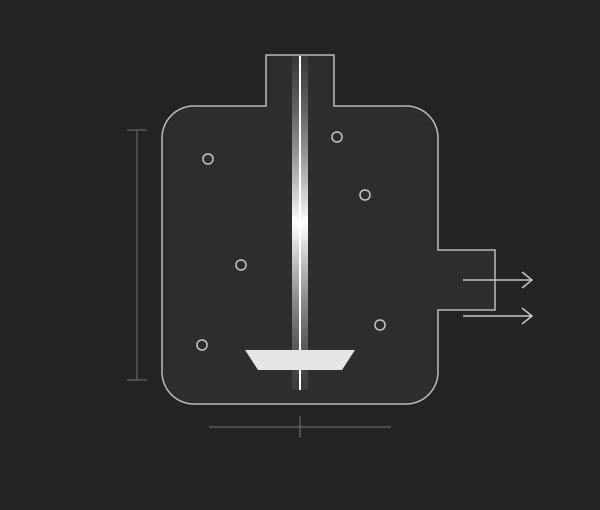
Air contains molecules that can interact with particles traveling through an instrument. In electron microscopy, residual gas can scatter or absorb electrons along their path. Reducing the gas density helps the beam reach the intended region with fewer unwanted interactions.
Vacuum describes a reduced-pressure environment, not absolute emptiness. Different parts of an instrument may require different conditions. The source, beam path and sample region do not necessarily share a single pressure requirement.
Surfaces are part of the space
Removing the gas initially inside a chamber is only part of the story. Gas can continue to enter through leaks, arise from a process or be released by the materials within the chamber. Together, these contributions form a gas load that pumping must address.
Outgassing includes molecules leaving surfaces or moving from within materials toward the vacuum. Water vapor can be significant in many high-vacuum situations. A system can therefore have a continuing gas load even when no external leak is present.
A condition, not a guarantee
Vacuum alone does not determine image quality. Pump vibration can disturb a sensitive measurement, and instrument design must account for the surroundings as well as gas removal. Some environmental electron-microscope configurations deliberately allow higher gas pressures in the sample region.
The useful question is which environment supports a particular observation. Pressure, residual gas, sample behavior and mechanical stability belong to that context. An introductory drawing can explain why gas matters, but it cannot specify a safe operating procedure or suitable settings for an instrument.
Further reading · vacuum and residual gas
- Edwards Vacuum: analytical instruments and electron microscopy
- Edwards Vacuum: sources of gas load and outgassing
General educational material. This reading does not describe AYEAYE LLC activities.